Analysis by Property Category
Palaces, Relais & Châteaux, eco-lodges, thalassotherapy, mountain, Paris, countryside: EcoIndex scores by segment.
Aucune catégorie ne dépasse la note D
Palaces and certified 5-star hotels
This is perhaps the most striking paradox of the study. The most prestigious properties — those investing the most in their environmental approach and charging the highest rates — display some of the worst digital scores.
A Parisian palace, one of only two holding the Clef Verte label in France, has a website with an EcoIndex score below 20 out of 100. A Relais & Châteaux castle-hotel in the 16th arrondissement, Clef Verte-certified and distinguished by a Michelin green star for responsible gastronomy, fares no better despite exemplary on-the-ground environmental commitment.
In Provence, a 5-star Relais & Châteaux wine estate in the Luberon, EU Ecolabel-certified and recognized for its eco-mobility and organic vineyard, shows a similar score. A 5-star Relais & Châteaux hotel near Aix-en-Provence, CSR-certified, presents the same gap between physical environmental excellence and digital negligence.
A 5-star Relais & Châteaux spa in Provence scores 52/100 — the "best" in the luxury segment, but still a D grade, far from sufficient. Its premium villa page weighs 16 MB and generates 65 HTTP requests. For a property where private pool villa rates exceed €1,000 per night, every additional loading second is a direct risk of losing a booking to Booking.com.
The first palace in France certified EU Ecolabel, in the Bordeaux region — pioneer of vinotherapy and luxury in harmony with nature for over 20 years — scores 41/100, grade D. Its environmental commitment is authentic and deep. But its website tells a different story.
A Relais & Châteaux in Les Baux-de-Provence, emblem of Provençal art de vivre and local sourcing, scores only 12/100 — grade F. A Michelin-starred 5-star near Avignon drops to 7/100, grade G.
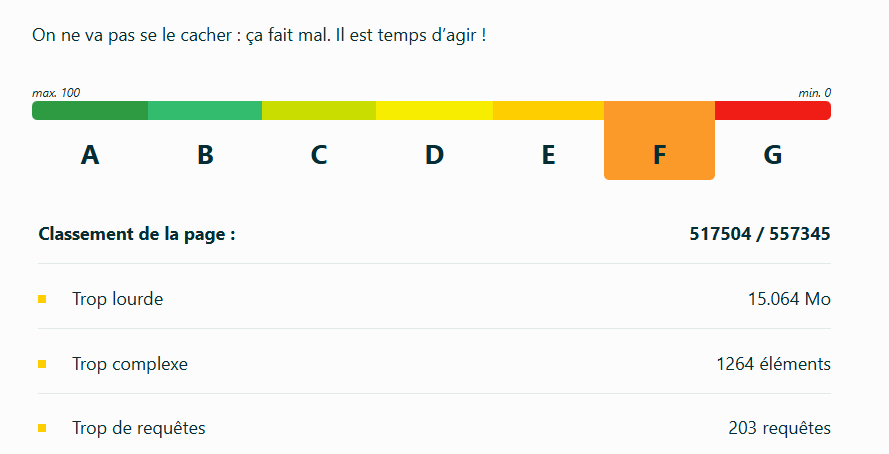
Example EcoIndex score — 5-star hotel
Relais & Châteaux: responsible luxury facing its digital reflection
Our study includes 8 Relais & Châteaux, several with Clef Verte or EU Ecolabel certification. This association, which brings together 580 exceptional hotels and restaurants worldwide and whose UNESCO Manifesto from 2014 advocates sustainable development, faces a concerning digital reality.
A 4-star Relais & Châteaux in the heart of the Loire Valley, Clef Verte-certified and overlooking one of France's most famous châteaux, displays an EcoIndex score that in no way reflects its eco-responsible commitments. A 5-star Relais & Châteaux in an iconic medieval village on the French Riviera, freshly Clef Verte 2026-certified, shows the same disconnect.
This is not an individual problem. It is a systemic issue affecting the entire network, including members most committed to environmental transition.
Eco-lodges and unique accommodations: the "Slow Tourism" paradox
This category displays the most striking disconnect — and the easiest to demonstrate. These properties make ecology their raison d'être and primary selling point.
A Clef Verte-certified eco-lodge in Picardy, presenting itself as a haven of "Slow Tourism" and digital disconnection, holds our study's record: its homepage weighs 65 MB, contains 2,644 DOM elements, and generates 457 HTTP requests. Score: 5/100, grade G — the minimum possible. For 1,000 monthly visitors, this single page consumes 43 liters of water and emits 2.9 kg of CO2. The irony is almost poetic: a place selling digital disconnection operates one of the most polluting websites in French hospitality.
A Japanese-inspired eco-lodge in the Bay of the Somme, an eco-resort with unusual concepts, eco-designed cabins EU Ecolabel-certified in Vaucluse — all present scores between E and G. The physical eco-design of these places (natural materials, local sourcing, low territorial impact) contrasts violently with the heaviness of their digital storefront.
Thalassotherapy and coastal hotels: Brittany and the Atlantic underperform
The French coastline, from Brittany to the Basque Country, hosts several properties historically committed to environmental stewardship. Our results show this commitment has not yet translated digitally.
A Clef Verte-certified thalassotherapy center in Morbihan scores 9/100. A thalasso hotel EU Ecolabel-certified since 2010 on a Breton island — which publicly states that "the notion of luxury is no longer incompatible with respect for the environment" — scores 10/100. A grand hotel from a national hotel group on the Emerald Coast, despite strong CSR policies, drops to 8/100.
In Brittany, a Relais & Châteaux EU Ecolabel-certified since 2014 on the Finistère coast scores 41/100, paradoxically making it one of the "best" coastal scores — but still a D grade.
Mountains and Alps: solar energy isn't enough
The mountain sector, particularly in Savoie and Haute-Savoie, concentrates properties emphasizing eco-responsibility, solar energy, and responsible water management. An eco-luxury mountain retreat in a Savoyard ski resort, investing in solar energy and water management, has a homepage weighing 44 MB and a score of 8/100, grade G. A boutique hotel on Lake Annecy, with a stated eco-responsible policy, scores 14/100, grade F.
These properties, often situated in exceptional natural environments, have every reason to align their digital storefront with the beauty and fragility of the landscapes they seek to protect.
Paris and urban areas: pioneers falling behind
The capital hosts several urban sustainable tourism pioneers. The first independent EU Ecolabel-certified hotel in Paris in the 16th arrondissement, the first Parisian Clef Verte hotel, a luxury eco-lodge EU Ecolabel-certified in the 11th, a pioneering hotel combining solar panels and dual EU Ecolabel + Clef Verte certification in the 14th — all present disappointing scores.
The Parisian eco-lodge case is particularly telling: a design frozen in the 2010s, a YouTube video as homepage background, logos arranged without visual coherence. For a property charging luxury rates to a demanding Parisian and international clientele, the dissonance between the promised and digital experience is striking.
A Clef Verte hotel group with three properties in western cities (Nantes, La Rochelle, Marseille) offers an interesting case study: two of its three sites score 5/100, grade G, while the third reaches 11/100. An internal digital inconsistency revealing the absence of a global web strategy despite a genuine environmental approach.
An urban Clef Verte refuge hotel in northern Paris suburbs, positioned on ecology and design, scores 28/100 — an improvement from the panel average but still grade E.
Countryside, vineyards, and châteaux: organic farming stops at digital
Organic wine estates and château-hotels invest heavily in organic agriculture, local sourcing, and heritage preservation. A 5-star organic wine estate in Provence, a hotel estate in the Luberon practicing organic agriculture — these two properties couldn't even be measured via EcoIndex (JavaScript blocking) and score F on WebsiteCarbon.
The first hotel in France EU Ecolabel-certified, a historic property in a castle in Vienne, scores 42/100 — the best in its category, but still a D grade. A Clef Verte estate in Catalonia, housed in a former winery, shows 14/100. A Clef Verte estate from a renowned hotel collection in Île-de-France scores 8/100.
The farmhouse of a world-renowned starred chef in Upper Provence, whose kitchen garden is a reference in sustainable gastronomy, offers a website scoring 38/100 — accompanied by chromatic choices (blue and pink) that hinder readability and don't reflect the refinement of the on-site gastronomic experience.